Espresso

Your espresso doesn't have to be bitter

Learn how to do it
Kaffeeecke in der Küchenzeile: Beanwatch Kaffee, Zuriga Kaffeemaschinen und Cappuccino mit Latte Art

Espresso represents concentration, intensity, and clarity. It is the foundation of many classics. Here you will find an overview of how to prepare it without bitterness and which beans work particularly well for it.

Espresso und Cappuccino Tassen auf einem blauen Tisch

What is an espresso?

An espresso is a short, concentrated coffee. It is brewed from finely ground beans with hot water and high pressure. Correctly prepared and with the right coffee beans, it is sweet, balanced, and aromatic.

Espresso is the base for various coffee beverages, such as Caffè Crème, Americano, and espresso with milk like cappuccino, flat white, cortado, and latte macchiato.

The Fundamentals of a Good Espresso

A balanced espresso is not a matter of chance. These fundamentals determine whether it tastes clear and sweet or unpleasantly bitter.
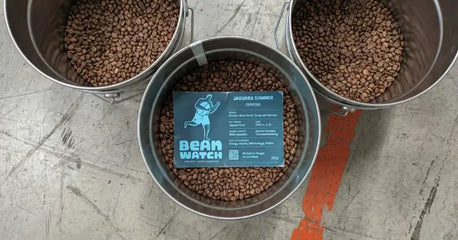
Frisch gerösteter Beanwatch Kaffee in Eimern zwischengelagert
1. The coffee beans
A good espresso doesn't start with the machine, but with the coffee bean. Specialty coffee has fewer defects that can cause bitterness. For more sweetness, aromas, and balance, and less bitterness, it's best to choose Specialty Coffee (Blog post: What is Specialty Coffee).
Zwei Probenzieher von einem Röster: eine helle Röstung und eine dunkle Röstung
2. The Roasting Process
The darker the espresso, the more bitterness finds its way into your espresso cup. As roasting time increases, sweetness and aromas, initially created by the Maillard reaction, are broken down. Bitter substances develop, while fruity and caramel notes are lost. For this reason, we recommend medium to light roasts.
Olympia-Beanwatch Kaffeemühle mahlt Kaffeepulver in den Siebträger hinein.
3. The Espresso Grinder
Far more important than the espresso machine is the coffee grinder. A good grinder grinds the coffee beans uniformly, allows for fine adjustments to the grind size, and operates reproducibly. Stay away from blade grinders. Conical or disc grinders are better. There are now detailed tests available for every price range that you can consider in your decision.
Roxy Espresso brüht gerade zwei Espresso in zwei Tassen hinein
4. The espresso machine
You don't need expensive portafilter machines to make good espresso. Usable results can also be achieved with affordable entry-level machines, a Moka pot (keyword: Bialetti), or a fully automatic coffee machine. The previously mentioned points are more important for a good espresso. Informative tests are available for various price ranges for both portafilter machines and fully automatic coffee machines.
WDT-Tool bei einem Nussbaum-Siebträger
5. Your Barista Skills
The portafilter machine has the potential to produce the best espresso, but it demands the most from you. Channeling and other brewing errors are your biggest adversaries on the way to delicious espresso. Their weapons are bitterness and sharp acidity. Easier, but not without pitfalls, are the Moka pot and automatic coffee machines.
Espazzola in der Brühgruppe von einer La Marzocco mit Wasserdurchfluss
6. Cleaning
Does your espresso taste bitter? When was the last time you cleaned your grinder and espresso machine? Cleaning is one of the biggest levers to improve your espresso. Coffee oils accumulate in your equipment, which can become rancid over time and spoil every brew. Remember: behind every good espresso is a clean grinder and a clean espresso machine.

The coffee beans are the most important basis for a good espresso

If you're tired of bitter espresso, it's worth checking out Beanwatch coffee beans. Our specialty coffees are deliberately light roasted. This preserves the natural sweetness, delicate acidity, and clear aromas, which result in a balanced and non-aggressive espresso.

Different Ways to Make Espresso

Among coffee lovers, there are sometimes strong opinions on which devices can produce "real" espressos. Beanwatch is open to all methods. The main thing is that it tastes good.

Orange La Marzocco Siebträgermaschine und Eureka Kaffeemühle in der Midcentury Küche

The portafilter machine

To make a good espresso, the barista has to work hard: they look for the right grind, prepare the coffee grounds in the portafilter, tamp it, and need the right brewing temperature. In return, they have the chance to unleash the true potential of the coffee bean.

Handhebelmaschine von Kees van der Westen

Lever espresso machine

The ultimate challenge for the barista. Because with this machine, a crucial variable is added: The brewing pressure is generated manually via a lever, making the espresso very directly controllable. Experience and intuition determine the result in the cup.

Kaffeevollautomat in einem Midcentury Regal

Automatic coffee machine

Who invented it? That's right, the Swiss. Because the first generations couldn't brew concentrated espresso, an extended version of espresso was specially invented: the "Kaffee Crème."

Morning Kapselmaschine am Fenster mit Ausblick auf dem Zürichsee

Capsule coffee machine

The capsule machine also calls Switzerland its home. With Nespresso and George Clooney, it conquered the world from Western Switzerland.

Moderne Mokkakanne auf einem modernen Gasherd

Ibrik

Ironically, in Italy, the home of espresso, hardly anyone has a portafilter machine at home. Instead, most people have a moka pot, which can work well with espresso beans. In addition to Bialetti, there are now many other moka pots that enhance domestic kitchens as design objects.

Nanopress am Ufer vom Zürichsee wird gerade benutzt

Outdoor Espresso

No one needs to forgo their espresso when hiking or camping anymore. There are now plenty of battery-operated or purely mechanically functioning devices available.

The Most Important Espresso Drinks at a Glance

An espresso is the base of many well-known coffee drinks. The ratio, length, and amount of milk are crucial. In this section, we introduce you to the most important espresso drinks and explain the differences concisely and clearly.

Ein Ristretto in einer Beanwatch Tassee steht auf einem Marmortisch

Ristretto

A very short espresso with a brew ratio typically of 1:1, i.e., 18g coffee to 18g beverage in the cup. Intense, syrupy taste with a full body.
Ein doppelter Espresso in einer Beanwatch Tassee steht auf einem Marmortisch

Espresso and the Doppio

Classic espresso is usually brewed at a ratio of 1:2 to 1:2.5 (for a doppio, about 18 g coffee to 36 or 45 g beverage). We personally prefer it lively, sweet with a pleasant acidity.
Ein Americano von aus Sitzperspektive fotografiert.

Americano

A double espresso that is extended with hot water after extraction. American occupation forces in post-war Italy supposedly preferred it this way. Hence the name.
An institution in Switzerland. The Café Crème is an extended espresso with a 1:10 ratio. To avoid bitterness, the grind must be coarser.
Typically, it's a simple espresso with a spoon of milk foam. Nowadays, it's often served with mini latte art.
In a Cortado, espresso and finely textured milk are balanced in a 1:1 ratio. Therefore, for 36g of espresso output, approximately 36g of milk foam is added.
A single espresso is supplemented with warm milk and milk foam in a ratio of approximately 1:3. In the 1990s, it was often served with fluffy, bath-foam-like milk foam, but nowadays, it is frequently seen served with finely pored milk foam designs (Latte Art).
The main difference from cappuccino lies in the amount of espresso: a flat white always uses a doppio as its base. It is also served in slightly smaller cups, achieving a milk foam ratio of about 1:2.
A milk-based drink with coffee. It is often simply called "latte" or "caffè latte". With 180 to 220g of milk, the 36 to 45g of espresso in the glass takes a back seat.

Espresso FAQs

The amount of caffeine in a cup depends on three key factors: the coffee bean, the amount of ground coffee used, and the serving size.

Coffee bean: Robusta beans are true caffeine powerhouses, containing between 2% and 4.5% caffeine. Arabica beans, by contrast, contain only 1.1% to 1.7% caffeine. In addition, caffeine levels can vary considerably between different Arabica and Robusta varieties.

Amount of ground coffee: The more coffee grounds you use in your portafilter, the more caffeine is extracted into your cup. This factor has a greater impact than the roast level, as caffeine remains largely unchanged during roasting.

Serving size: Caffeine is water-soluble. A Café Crème, for example, contains more caffeine than an espresso when prepared with the same amount of coffee grounds, because the larger volume of water extracts more caffeine from the coffee.

If you'd like to know the exact caffeine content of different coffee drinks, take a look at the table in our article about caffeine, where we compare the caffeine content of various espresso-based beverages.

Since a 2015 assessment by the European Food Safety Authority (EFSA), the figure of up to 400 milligrams of caffeine per day has been widely cited as a safe intake level for healthy adults. If you prepare your espresso the way we like it, using 18 grams of ground coffee and extracting 42 grams of espresso, you'll end up with roughly 70 to 100 milligrams of caffeine per cup. Based on those numbers, up to four cups per day should be well within the recommended limit.

The volume of an espresso depends largely on the barista. If you're brewing espresso at home, the final yield is determined by your recipe and machine settings.

As a reference, we brew our light-roasted espresso coffees using a 1:2.5 brew ratio. With 18 grams of ground coffee, this results in around 42 millilitres of espresso in the cup.

Dark-roasted coffees often perform better with a 1:2 ratio. Using the same 18 grams of coffee, you would aim for a yield of approximately 36 millilitres.

The word “espresso” comes from the Italian term espressivo, referring to a coffee that is prepared specifically for an individual customer. The term emerged at a time when this style of coffee had to be ordered directly at the bar of a café and brewed on demand.

Contrary to a widespread misconception, the word is not derived from “express,” even though the association with a quickly prepared coffee seems plausible. Nor does espresso originate from the Latin word expressum (“to press out” or “to squeeze out”).

So, strictly speaking, an espresso is never an “expresso coffee.” If anything, it is closer to being an “exclusive coffee”: a drink prepared especially for you.

You type it in a hurry and hit Enter before noticing the mistake. After all, you'd never spell espresso with a double “s” at the beginning, would you? Or would you?

Don't worry. Around 2,000 people search Google for “esspresso” every year. Another amusing, but still incorrect, variation is “essepresso”. Perhaps the roughly 140 searchers were trying a little too hard to embrace the Italian accent.

The more attentive coffee drinkers know there has to be a double “s” somewhere. But where exactly does it go? Over the past 12 months, around 320 people opted for the wrong version and searched for “esspreso”.

The word espresso demands quite a bit from our fingers. Its letters are spread across the entire width of a QWERTY keyboard. No wonder that around 170 people seem to run out of steam before reaching the final letter, turning espresso into “espressp”.

Even more thoroughly brewed are the coffee lovers searching for “esppreso” (75 searches). But we'll forgive them. After all, there are still plenty of people who associate espresso with “express” and end up attaching nothing more than an “o” to the end.