

The cappuccino is one of the most famous coffee drinks in the world. In this article, we portray the cappuccino and answer questions about cappuccino preparation, caffeine, and calories. This article explains the classic drink in a factual, understandable, and practical way.
Quick Overview
- A classic cappuccino consists of a single espresso, finely frothed milk, and a balanced cup size of approximately 150–180 ml.
- The often-cited "rule of thirds" is more of a myth. In practice, the espresso makes up only a small part of the drink.
- Caffeine and calorie content depend almost exclusively on the amount of espresso and milk chosen, not on the cup size.
- Compared to Latte Macchiato, Flat White, and Cortado, the cappuccino primarily differs in its coffee-to-milk ratio.
Table of Contents
- Cappuccino: The Basics
- What is a Cappuccino?
- How do you make a cappuccino?
- Can You Drink a Cappuccino Cold?
- What is the difference between Cappuccino and Latte Macchiato?
- Conclusion
Cappuccino: The Basics
Although the cappuccino is one of the most popular classics of Italian coffee culture, it actually has its origins in Austria. The Kapuziner was served in Viennese coffee houses in the 19th century: a drink in which the waiter mixed coffee and milk until it resembled the brown habit of Capuchin monks. With the advent of the espresso machine in Italy, its steam was increasingly used to heat and froth milk, and the cappuccino was born.

What is a Cappuccino?
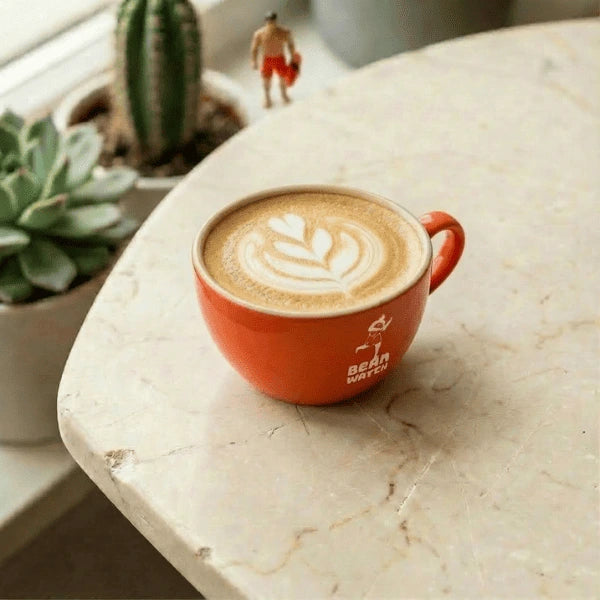
A cappuccino is a coffee drink made from a single espresso, milk, and milk foam. Typically, the espresso-to-milk ratio is between 1:3 and 1:4, with a top foam layer of one to two centimeters.
The "rule of thirds," which states that a cappuccino consists of equal parts of these three ingredients, persists stubbornly. However, most cappuccinos in Italian coffee bars are served in cups measuring 150 to 180 ml. This means the espresso only accounts for about one-sixth of the total volume of the drink in the cappuccino cup.
At least since the nineties, cappuccino has been served in increasingly larger cups with sometimes grotesque foam formations in large coffee chains and elsewhere outside Italy. The Specialty Coffee scene has responded with new drinks, but also with a further development of the cappuccino. Although there is no uniform definition, cappuccino is typically served in smaller cups again, which increases the proportion of espresso and thus makes it stronger. Instead of piles of foam, cappuccino is served with latte art. A concept that has now spread beyond the Specialty Coffee industry.
When do you drink cappuccino?
At the latest when preparing for the next trip to Rome or Florence, the question involuntarily arises: When do you drink cappuccino in Italy? You don't want to stand out negatively and make a faux pas. While you can enjoy your milky coffee almost around the clock everywhere else without being frowned upon, thanks to Decaf Cappuccino even after 4 PM, your cappuccino order after 11 AM can already lead to headshakes.

In Italy, milky coffee is considered a breakfast option. This has a lot to do with tradition, but also with the assumption of many Italians that dairy products slow down digestion. Presumably, the fact that 40 to 50 percent of the Italian population is lactose intolerant has had a strong influence on culture and practice. For comparison: in Switzerland, only 20 percent are lactose intolerant.
The cappuccino time in Italy ends at 11 AM, at a push 12 PM. In Switzerland, you can also drink your cappuccino in the afternoon. At least we at Beanwatch won't give you a dirty look.
How do you spell cappuccino?
Italian is one of the most beautiful languages, but not everyone finds its spelling easy. So: C-A-P-P-U-C-C-I-N-O. With double p and double c, so not Cappucino, Capuccino, or Capucino. No ch like in Cappuchino or Capuchino. And certainly not Kapoutsino!
The plural form ending with "i", i.e. Cappuccini, is correct. But the ending with "-s" is also allowed in the German language.
How do you make a cappuccino?
- Cappuccino preparation begins with a freshly brewed, single espresso. We recommend a brewing ratio of 1 to 2.5. This means for 10 g of coffee grounds, 25 ml of extracted espresso in the cup.
- The cappuccino cup should hold 150 to 220 ml, depending on how strong you prefer your cappuccino.
- You should preferably froth the milk using the steam wand of your espresso machine to create fine-pored foam and avoid the fluffy foam of the nineties. With the latter, you also can't draw beautiful milk foam pictures.
→ Find out in our ultimate milk comparison, which milk froths best. - The ideal milk temperature is approximately 60 °C, that's before the milk jug gets too hot in your hand.
What does a cappuccino consist of?
The classic cappuccino recipe consists exclusively of espresso, milk, and milk foam. Additions such as sugar or cocoa powder on top of the foam are optional, but not part of the classic recipe.
How much caffeine does a cappuccino have?
The basis of a cappuccino is a single shot, meaning about 18–25 ml of espresso. This results in about 60 to 80 mg, depending on the coffee bean variety. Robusta coffee beans, for example, contain more caffeine than Arabica coffee beans.
→ In our article about caffeine, you can find out how much caffeine a cappuccino has compared to espresso, filter coffee, and other coffees.
Which milk for cappuccino?
For a creamy, fine-pored foam quality in cappuccino, we recommend fresh whole milk with a fat content between 3.5 and 3.9%, a protein content of about 3.3%, and that it is pasteurized, not ultra-pasteurized. Among plant-based alternatives, Barista Editions are specially made for latte art-capable milk foam.
→ Find out in our detailed comparison which milk froths best.

How many calories does a cappuccino have?
Calories depend on the milk or plant-based alternative chosen. We prefer our cappuccino with fresh whole milk, which contains 3.5–3.9% fat depending on how it's made. At 130 ml per cappuccino cup, this results in about 85 kcal. The Barista Editions of plant-based alternatives often use a higher fat content to make the milk froth better. These achieve similar values to fresh whole milk.
Calories per 100 ml of cappuccino
- with fresh whole milk: 55–60 kcal
- with oat drinks Barista Edition: 50–55 kcal
Can You Drink a Cappuccino Cold?
Summer can get hot, and not everyone enjoys drinking hot coffee when temperatures climb above 30 °C. Fortunately, coffee tastes just as good cold, especially when you use high-quality coffee beans. But which cold cappuccino variations are available? The two most popular are the Iced Cappuccino and the Freddo Cappuccino. An Iced Cappuccino is prepared by brewing a shot of espresso directly over ice and topping it with warm milk foam. A Freddo Cappuccino takes a little more effort. The espresso is shaken with ice in a cocktail shaker until foamy, while the milk is frothed cold using skimmed milk.
→ Discover in our coffee recipes how to make a Freddo Cappuccino.
What is the difference between Cappuccino and Latte Macchiato?
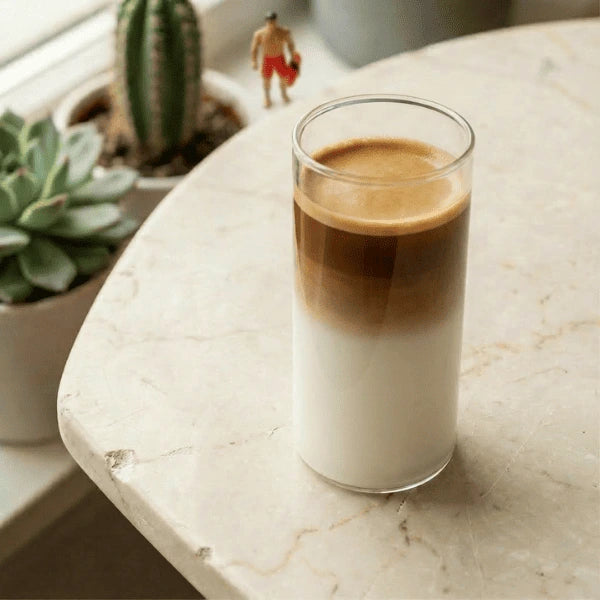
Both drinks use a single espresso shot. The difference between cappuccino and latte macchiato lies in their structure and milk content. A cappuccino is served in a 150–180 ml cup. First, the espresso is extracted into the cup. Then, fine-pored milk foam is added to the cup, ideally with latte art. A latte macchiato is typically served in a glass. The latte macchiato has significantly more milk, 200–250 ml. This frothed milk is added to the glass first, followed by the single espresso.


Which is stronger: Latte Macchiato or Cappuccino?
If one adheres to the classic recipes, then both a Latte Macchiato and a Cappuccino contain a single espresso shot of about 18–25 ml. The difference lies not in the caffeine content, but in the milk content and the structure of the drink.
For a Latte Macchiato, the espresso is added to a significantly larger amount of milk. With an espresso-to-milk ratio of about 1 to 8, the coffee is more diluted, making it taste milder.
The cappuccino, on the other hand, is served in a smaller cup and has a higher espresso-to-milk ratio of approximately 1 to 6. This keeps the coffee flavor more prominent and is generally perceived as stronger, even though both drinks contain the same amount of espresso.
→ In our Latte Macchiato article, we delve into the origin, recipe, and preparation of this introductory coffee.
| Feature | Cappuccino | Latte Macchiato | Flat White | Cortado |
|---|---|---|---|---|
 |
 |
 |
 |
|
| Shots | Single Espresso | Single Espresso | Double Shot | Double Shot |
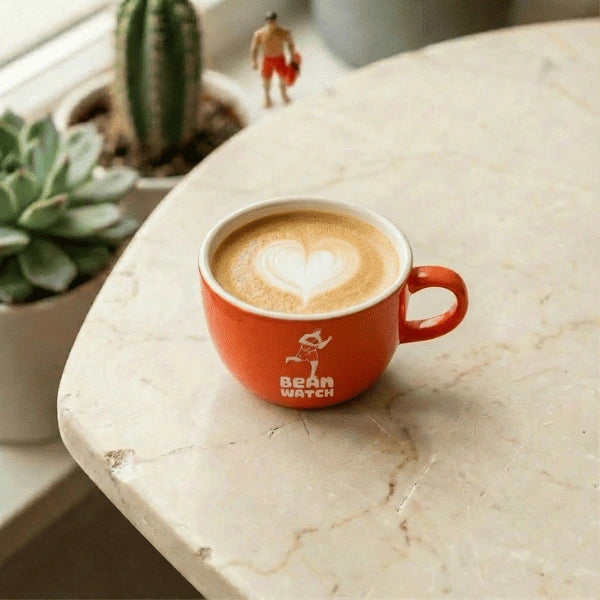
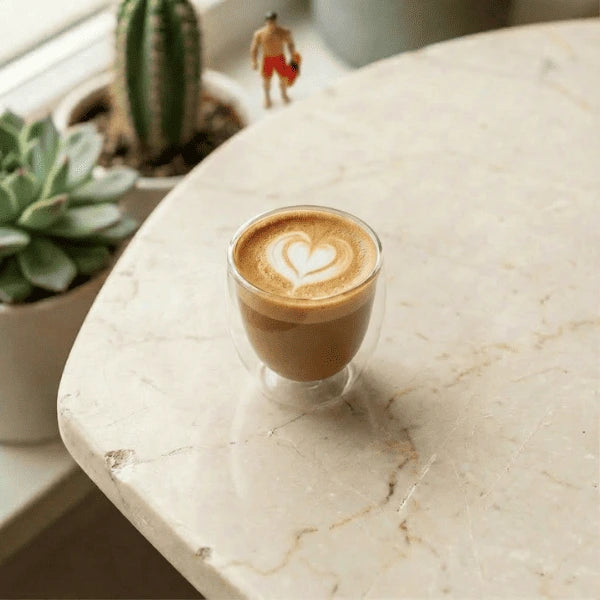
| Espresso volume | approx. 18–25 ml | approx. 18–25 ml | approx. 36–45 ml | approx. 36–45 ml |
| Milk volume | approx. 130–160 ml | approx. 200–250 ml | approx. 120–150 ml | approx. 36–45 ml |
| Espresso : Milk Ratio | approx. 1 : 6 | approx. 1 : 8 | approx. 1 : 3 | approx. 1 : 1 |
| Milk type | hot milk with a distinct layer of milk foam | hot milk with milk foam | hot milk, very fine microfoam | hot milk, little to no foam |
| Caffeine content | approx. 60–80 mg | approx. 60–80 mg | approx. 120–160 mg | approx. 120–160 mg |
| Serving size | approx. 150–180 ml | tall glass | approx. 150–180 ml | approx. 72–90 ml |
| Preparation logic | Single espresso, hot milk, foam on top | Milk first, then espresso | Double espresso, then finely textured milk | Espresso and milk mixed directly |
| Taste | balanced, creamy, coffee-focused | very milky, mild | strong, velvety, not very airy | strong, round, not very milky |
| Origin / Influence | Italy | Italy | Australia / New Zealand | Spain |
| Learn more | – | Read the Latte Macchiato portrait | To the Flat White article | More about the Cortado |
Conclusion
The cappuccino is one of the most well-known milk coffee classics with a rich history that began in Austria, achieved worldwide fame as an espresso variant in Italy, and experienced a revival as a trendy coffee drink through the Specialty Coffee scene. A simple shot of espresso, six times the amount of milk or milk foam, and the coffee enjoyment is complete. This makes the cappuccino the right choice for those for whom a flat white is too strong and a latte macchiato is too mild.


