

The Espresso Macchiato is a classic of Italian coffee culture. It has few ingredients, clear rules, and yet plenty of room for individual interpretations. For a long time, the Espresso Macchiato was a hack for coffee lovers who found espresso alone too bitter but didn't want to forgo its kick. In this article, we show that espresso with milk still has its place, even when the espresso itself is no longer bitter.
Quick Overview
- An Espresso Macchiato is a classic espresso "marked" with a very small amount of milk or milk foam.
- The name Macchiato comes from Italian and means "stained" or "marked."
- The espresso is central. The milk serves solely for a slight rounding off.
- There are classic and modern interpretations, which primarily differ in the ratio of espresso to milk.
Table of Contents
- Espresso Macchiato: The Basics
- What is an Espresso Macchiato?
- How do you make an Espresso Macchiato?
- Macchiato Macciato: Espresso Macchiato at ESC 2025
- Conclusion
Espresso Macchiato: The Basics
The Espresso Macchiato belongs to the family of classic espresso drinks and plays a special role within it. It consciously positions itself between purist espresso and milk-heavy coffee variations. What is crucial here is not the quantity of milk, but its function. It is intended to mark the espresso, not change it.
At its core, every Espresso Macchiato is based on the same fundamental elements as an espresso. Freshly ground coffee, correctly extracted, served in a small cup. The milk only comes into play afterwards and is used purposefully and sparingly. This very restraint distinguishes the Espresso Macchiato from many other coffee drinks.
To understand the Espresso Macchiato, one should therefore not view it as a diluted espresso, but as an independent form of preparation. It is aimed at people who appreciate the character of espresso but prefer a minimal rounding off. This balance is the key to its continued success.
What is an Espresso Macchiato?
An Espresso Macchiato is a classic espresso "marked" with a small dollop of milk or milk foam. The Italian word means "stained." It refers to an espresso that is very lightly enhanced with milk. The term caffè macchiato is also often used for this. Both terms refer to the same drink. The milk is not meant to dilute the espresso, but merely to round it off.
The drink originated in Italian espresso bars, where espressos were usually brewed very quickly and lined up on the counter to be picked up by the waiters. However, if a customer ordered their espresso with a spoon of milk, it was impossible for the waiters to distinguish it from the other espressos due to the crema. The baristas therefore began to "stain" or mark the espresso cups with a little milk foam.

The modern Espresso Macchiato is a further development of its classic predecessor. A central point continues to be its base: the espresso (or even the Espresso Doppio Macchiato, if the guest insists on a double shot of espresso). Nowadays, the espresso cup is filled to the rim with milk foam, especially when the barista wants to demonstrate their latte art skills even in small cups (read in our blog post which milk is best for frothing).
There are numerous incorrect spellings surrounding the term Espresso Macchiato. Common variants include macaito, macciato, or machiato. These arise because the word is of Italian origin and is often written phonetically. The correct spelling is exclusively macchiato with a double c and h. All other variants are spelling errors.
Furthermore, there is a certain risk of confusion with other espresso drinks. A Latte Macchiato differs greatly from its little brother. While the Espresso Macchiato only contains a "dollop" of milk, the Latte Macchiato consists almost entirely of milk. The Cortado is also a different drink, as the espresso and milk quantities are combined in a 1:1 ratio. The "Caramel Macchiato", on the other hand, is a drink that Starbucks made popular and which has contributed to further confusion. The Caramel Macchiato is a Latte Macchiato decorated with caramel sauce.
| Feature | Espresso Macchiato | Espresso Macchiato (Modern) | Cortado | Latte Macchiato | Caramel Macchiato |
|---|---|---|---|---|---|
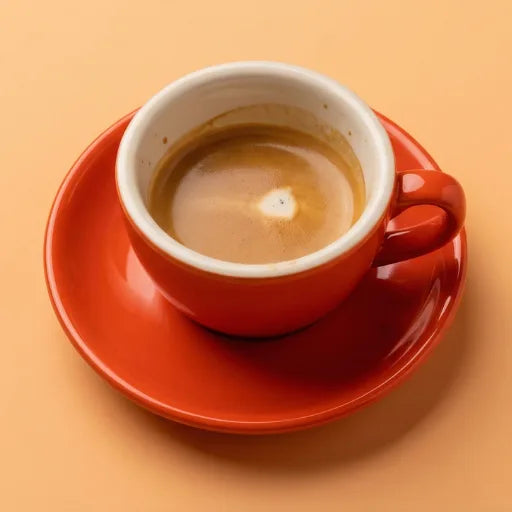
|
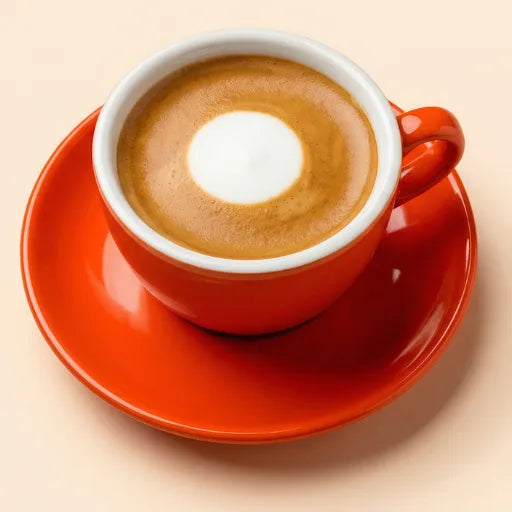
|
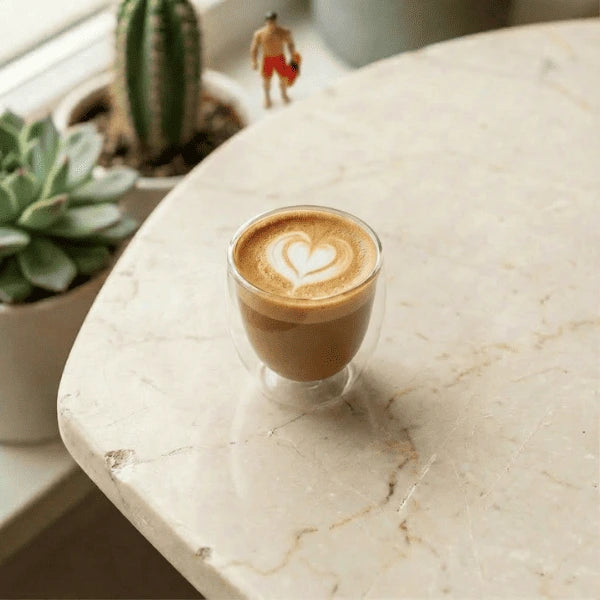
|
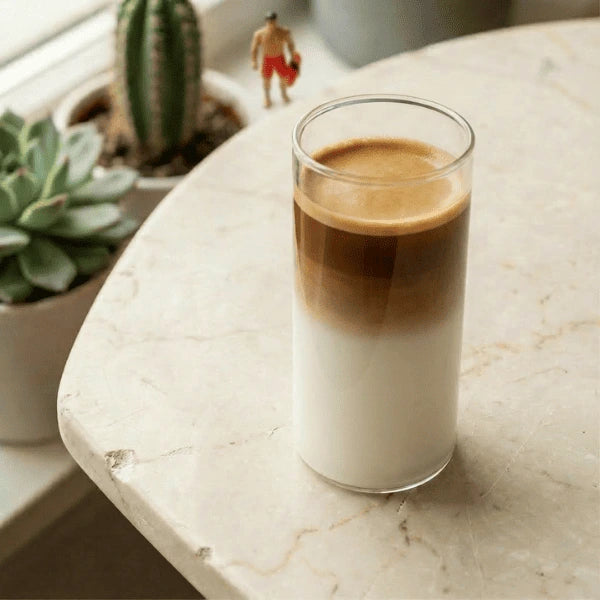
|
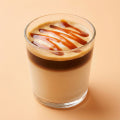
|
|
| Espresso quantity | approx. 18–25 ml | approx. 18–25 ml | approx. 36–45 ml | approx. 18–25 ml | approx. 25–30 ml |
| Milk quantity | approx. 5–10 ml | approx. 18–23 ml | approx. 36–45 ml | approx. 200–250 ml | approx. 250–300 ml |
| Espresso-to-milk ratio | approx. 5 : 1 | approx. 1 : 1 | approx. 1 : 1 | approx. 1 : 10 | approx. 1 : 10 |
| Milk type | Milk foam or a drop of milk | Fine milk foam with latte art | Hot milk, little foam | Hot milk with milk foam | Hot milk with milk foam |
| Sweetener | None | None | None | None | Vanilla syrup and caramel sauce |
| Caffeine content | approx. 60–80 mg | approx. 60–80 mg | approx. 120–160 mg | approx. 60–80 mg | approx. 75–150 mg depending on size |
| Serving size | Small espresso cup | Small espresso cup | Small cup or glass | Tall glass | Large glass or mug |
| Preparation method | Espresso with a milk mark | Espresso topped with frothed milk | Espresso and milk mixed | Milk first, espresso second | Milk and syrup first, espresso on top |
| Taste | Very strong, slightly rounded | Strong, creamy, balanced | Balanced, mild | Milk-forward, smooth | Sweet, dessert-like |
| Origin / Influence | Italy | Specialty Coffee scene | Spain | Italy | USA, popularized by Starbucks |
| Learn more | – | – | Read the Cortado Guide | Learn more about Latte Macchiato | – |
How do you make an Espresso Macchiato?
To prepare an Espresso Macchiato, you first brew a fresh espresso. At the same time, froth a small amount of milk.
Classic Espresso Macchiato: If you follow the traditional recipe, add a small dollop of milk foam to the espresso with a spoon (alternatively, you can simply add a drop of hot milk).
Modern Espresso Macchiato: If, on the other hand, you want to train your latte art skills by creating delicate patterns in a small espresso cup, then you are following the modern interpretation. The easiest and most common design is a simple circle. However, even a heart should be achievable after only a few attempts.

Macchiato Macciato: Espresso Macchiato at ESC 2025
The Espresso Macchiato also gained international attention through the Eurovision Song Contest 2025. Estonian artist Tommy Cash brought the drink to the big stage with his song “Macchiato Macciato”. That does not make the espresso drink any worse. Unless, of course, you let the catchy tune ruin your coffee experience.
In the lyrics, the Espresso Macchiato serves as a symbol of style, eccentricity, and European coffee culture. The coffee represents a blend of everyday life, enjoyment, and ironic exaggeration. Throughout the song, the Macchiato appears as a recurring motif used to convey nonchalance and coolness. The song helped make the term Espresso Macchiato temporarily popular even outside traditional coffee circles.
Conclusion
The Espresso Macchiato is far more than just an espresso with milk. It is a product of Italian coffee bar culture, born from pragmatism and simplicity. Originally, it was a subtle adjustment for people who found espresso too intense without wanting to lose its caffeine kick. Within the Specialty Coffee scene, the Espresso Macchiato evolved into an espresso drink that showcases latte art in a small espresso cup. The modern Espresso Macchiato is particularly popular among people who enjoy milk foam but still want espresso to remain the star of the show.


