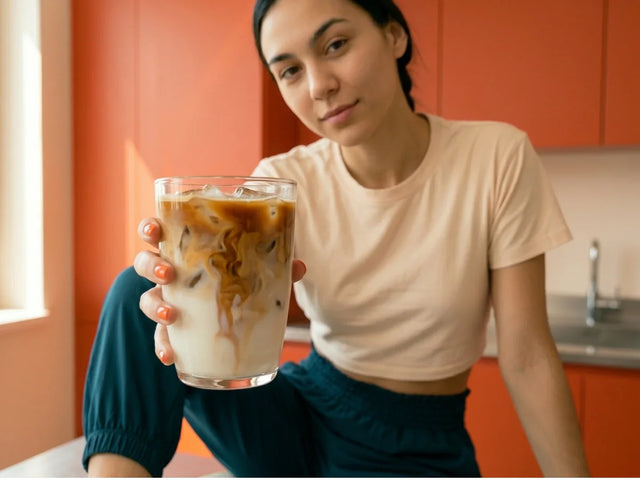
Freddo Cappuccino Recipe

Learn how to make a Freddo Cappuccino and enjoy a refreshing Greek-style iced cappuccino on hot summer days. Invented in Greece, this coffee classic reaches a whole new level when prepared with specialty coffee. All you need is a cocktail shaker, if you don’t already have one, to make it at home.

Prep and preparation time: 10 minutes
Caffeine and nutrition: 80 mg , 36 kcal
Rate this recipe
Rating is loading...
Last updated on July 3, 2026
Freddo Cappuccino Rezept

What do I need for a Freddo Cappuccino?

Eine Hebelmaschine von Kees van der Westen auf blauem Hintergrund
Portafilter machine
Mit der Comandante Handmühle wird gerade Filterkaffee gemahlen
Grinder
Pourover aus der Vogelperspektive
Coffee Scale
Hochwertiger Edelstahl-Cocktail-Shaker mit polierter Metalloberfläche auf heller Marmorarbeitsfläche
shaker
Goldfarbener Barlöffel mit gedrehtem Griff auf dunkelblauer Marmoroberfläche mit heller Maserung, fotografiert im minimalistischen Premium-Stil.
Bar spoon
Ein blauer Mixer in einer Küche mit einem Mischbecher, wo der Café Frappé gemixt wird.
Blender
Besides your espresso machine setup, you’ll need a cocktail shaker, a spindle mixer (with a rotating disc at the end of the shaft) and a bar spoon to gently pour the ingredients into the glass. If you don’t have a spindle mixer, you can also use a handheld milk frother to create cold milk foam.

How to make freddo cappuccino

Ingredients

For 1 glass
18 g coffee beans (Brew Ratio 1:2.5)
1 tsp sugar syrup (optional)
200 g ice cubes
100 ml skimmed milk (max. 0.5%)

Preparation

1
Extract the espresso into a small milk pitcher so you can easily and cleanly pour it into the shaker afterwards
18 g
coffee beans (Brew Ratio 1:2.5)
1 tsp
sugar syrup (optional)
Extract the espresso into a small milk pitcher so you can easily and cleanly pour it into the shaker afterwards

Always grind your coffee beans fresh before brewing, as pre-ground coffee quickly loses its freshness and aroma. Prepare and tamp the portafilter as you would for any espresso. Brew a double espresso into a small pitcher or cup so you can easily pour it into the shaker afterwards.

If you'd like to sweeten your Freddo Cappuccino, now is the time to do it while the espresso is still hot. Add the sugar syrup directly to the hot espresso and stir until it has fully dissolved.

Tip: Use high-quality coffee beans with a light to medium roast, and you may not need any sugar syrup at all.

2
Shaking cools the espresso while incorporating air, giving it its signature light and creamy texture.
200 g
ice cubes
Shaking cools the espresso while incorporating air, giving it its signature light and creamy texture.

Fill a serving glass with ice cubes.

Add two or three ice cubes to a cocktail shaker, then pour in the freshly brewed espresso.

Shake vigorously until the espresso is cold and covered with a fine layer of foam. Shaking incorporates air, creating the signature smooth and creamy crema that makes a Freddo Cappuccino unique.

Julia, the Beanwatch barista, strains the shaken espresso through a fine mesh strainer into a glass filled with ice cubes. Step three of the Freddo Cappuccino recipe.
Strain the shaken espresso through a fine mesh strainer into a glass filled with ice.
Julia, the Beanwatch barista, strains the shaken espresso through a fine mesh strainer into a glass filled with ice cubes. Step three of the Freddo Cappuccino recipe.
Strain the shaken espresso through a fine mesh strainer into a glass filled with ice.

Strain the chilled, airy espresso through a fine mesh strainer into the glass with the ice cubes.

3
The bar spoon lets you gently pour the cold milk foam into the glass, creating the Freddo Cappuccino's signature layered appearance.
100 ml
skimmed milk (max. 0.5%)
The bar spoon lets you gently pour the cold milk foam into the glass, creating the Freddo Cappuccino's signature layered appearance.

For a Freddo Cappuccino, we use cold frothed milk. Don't use the steam wand on your espresso machine.

This is where a spindle mixer comes in. It creates a dense, silky cold milk foam with a fine texture.

Finally, pour the cold milk foam gently over a bar spoon into the glass so the espresso and milk remain beautifully layered.

Tip: If you don't want to buy a spindle mixer, a handheld milk frother is an affordable alternative for making cold milk foam.

Why use skim milk? Skim milk produces a more stable cold foam than whole milk because its lower fat content (0.5% instead of 3.9%) allows the proteins to stabilise the air bubbles more effectively.

Learn more in our article about milk foam.

Caffeine & Nutrition Facts

80 mg
Caffeine
36 kcal
Energy
0.2 g
Fat
5.0 g
Carbohydrates
3.4 g
Protein
Values per glass. Values exclude optional ingredients Add approximately 12–17 kcal for each teaspoon of sugar syrup.

More Refreshing Espresso Drinks

Beanwatch-Barista Julia performt neben einem fertig geschichteten Espresso Tonic mit Zitronenscheibe im Glas auf der Edelstahl-Arbeitsfläche einer rotorangen Küche.
★★★★★
4,7 (3)
Make the summer hit at home: the Espresso Tonic combines a fruity, anaerobically processed espresso with sparkling, pleasantly bitter tonic water.
Julia reicht mit einer japanischen Verbeugungsgeste den fertigen Dirty Matcha Latte — drei Schichten sichtbar im Glas, Tatami-Raum mit Zuriga-Geräten im Hintergrund.
★★★★★
5,0 (1)
The Dirty Matcha Latte combines Japanese tea culture with modern coffee culture and delights with its striking appearance and well-balanced flavour.

Frequently Asked Questions

Freddo Cappuccino literally means "cold cappuccino". The word freddo is Italian for "cold" and comes from the Latin word frigidus. Despite its Italian name, the Freddo Cappuccino was invented in Greece and Cyprus.

The Freddo Cappuccino traces its origins to Yiannis Iosifidis, founder of Kafea Terra, the Greek distributor of the Italian coffee brand illy.

He introduced the Freddo Espresso in 1991 as an alternative to the Café Frappé, which had long been made in Greece with Nescafé instant coffee and dominated coffee consumption during the summer, hurting sales of espresso beans across the industry.

The two drinks are very similar but differ in both preparation and texture. For an Iced Cappuccino, hot espresso is brewed directly over ice before warm frothed milk is poured on top. In a Freddo Cappuccino, both the espresso and the milk foam are served cold.

Another key difference is the texture. For a Freddo Cappuccino, the espresso is shaken vigorously with ice in a cocktail shaker, incorporating air and creating a smooth, foamy consistency. The milk is frothed cold with a spindle mixer or a handheld milk frother and is never heated.